

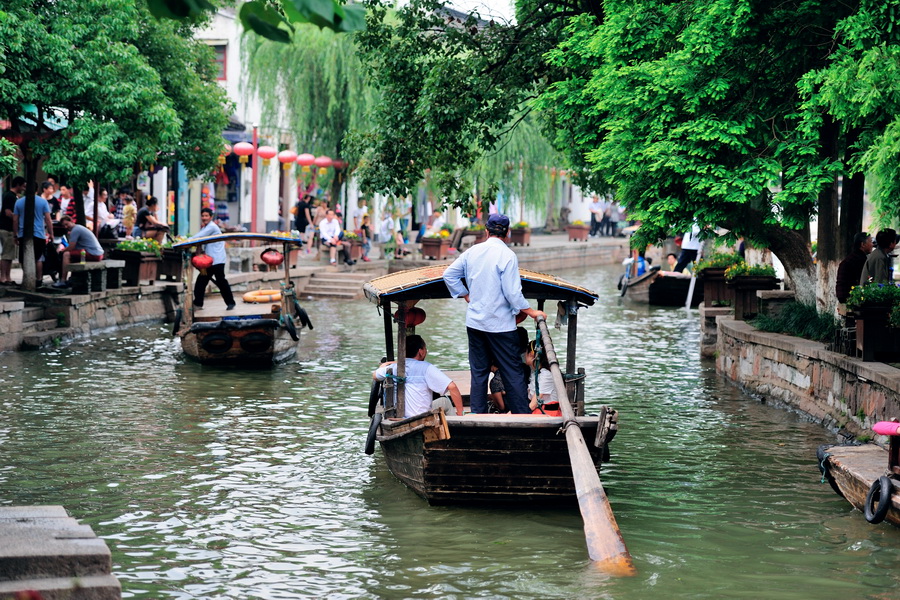
Zhujiajiao (朱家角), often referred to as the “Venice of Shanghai” or as the "Pearl of the south of the Yangtze River", is one of China’s most cherished water towns and a romantic destination. Crossed by Dragon river, it is located in Qingpu district, about 50 kilometres west of Pudong New Area in Shanghai. Thanks to convenient transport connections, it is easily accessible for a day trip, offering a striking contrast to the city’s skyscrapers and traffic.
Travellers come here for a peaceful escape in search of a different rhythm of life filled with centuries-old tradition and architectural marvels.
Zhujiajiao Water Town is also celebrated for its delicious local cuisine. Family-run eateries serve rice-based snacks, soft-filled traditional sweets, and simple dishes prepared with freshwater fish and shrimp. These flavours embody the everyday food culture of the region and enrich the experience of wandering through this ancient water town.
Zhujiajiao Water Town Tours
Depending on your availability and personal interests, you may choose to visit Zhujiajiao Water Town on astraightforward day trip or include it as part of a broader itinerary connecting several key regions of China.
The 1-day Zhujiajiao Water Town Tour from Shanghai, is ideal if you stay in the city and wish to spend a full day exploring the historic canal town. The programme typically includes a boat ride along the waterways, an introduction to Zhujiajiao’s traditional architecture, a visit to the refined Kezhi Garden, and time to browse for locally made crafts along North Street, before returning to Shanghai and its fast-paced urban rhythm.
For a broader view of the country, the 10-day Central China Discovery Tour connects several major cultural centres. Beginning in Beijing with visits to the Forbidden City and the Badaling section of the Great Wall, the route continues to Xi’an and its Terracotta Army, includes Chengdu and its Giant Buddha, and concludes in Shanghai with a walk along the Bund. Within this wider context, Zhujiajiao offers a tranquil stopover compared to China’s great cities.
Travellers seeking a deeper engagement with both history and landscape may prefer the 12-day Central China Classic Tour, which presents a more extensive itinerary. Walks through ancient cities are balanced with visits to natural landmarks, while encounters with modern megacities are complemented by time spent in traditional towns and villages. Within this structure, Zhujiajiao Water Town stands out as one of the most enchanting stops, characterised by picturesque waterways and unique views shaped by centuries of daily life.
Whichever route is chosen, Zhujiajiao Water Town reveals a traditional environment that remains closely connected to China’s wider cultural landscape, offering insight into ways of life that continue to inform the country’s present.
Best time to visit Zhujiajiao Water Town
Zhujiajiao Water Town can be visited year-round, yet spring and autumn are generally regarded as the most comfortable seasons for most travellers. They both offer particularly favourable conditions, with average daytime temperatures ranging from around 15 to 25 °C (59–77 °F). These seasons are ideal for walking along the canals, visiting gardens, and exploring the historic neighbourhoods on foot. In spring, fresh greenery softens the stone bridges and waterways, while autumn brings clearer air and gentle light, creating balanced conditions for photography.
Summer in Zhujiajiao is warm and humid, with daytime temperatures typically reaching 24–30 °C (75–86 °F). Rainfall is more frequent, particularly in the afternoons, which can make extended walks less convenient during the hottest part of the day.
Winter is colder, with daytime temperatures usually ranging between 4 and 10 °C (39–50 °F). Overcast days may soften the visual contrast of the canals and water surfaces compared to warmer seasons. However, winter offers a quieter atmosphere, fewer visitors, and a slower pace, making it an appealing time for those who prefer a more tranquil experience of the water town.
History of Zhujiajiao Water Town
Zhujiajiao originated as a small settlement established around 1,700 years ago beside a dense network of waterways and trade routes in southern China. Archaeological finds in the surrounding area suggest that human activity here dates back much further, with evidence of habitation reaching as far as 5,000 years ago. The town’s name, which may be translated as “Zhu family corner”, reflects a traditional pattern in Chinese toponymy, where place names are linked to the surnames of early settler families.
For many centuries, Zhujiajiao operated as an important trading port, closely connected to the waterways linking the western districts of present-day Shanghai with neighbouring provinces. During the Song (960–1279) and Yuan (1271–1368) dynasties, the settlement developed its first organised markets. Its status was further consolidated during the reign of the Ming dynasty’s Wanli Emperor (1573–1620), when Zhujiajiao was formally recognised as a town and strengthened its role as a commercial hub within the Jiangnan region.
During the Qing dynasty (1636–1912), Zhujiajiao further consolidated its position as a regional distribution centre, particularly for rice, textiles, and handicrafts. Much of the built fabric that survives today dates from this period. Although the town’s economic significance gradually declined in later years, its stone bridges, canal-side neighbourhoods, and historic buildings continue to convey a clear picture of life in a water town during the late imperial era.
Things to Do in Zhujiajiao Water Town
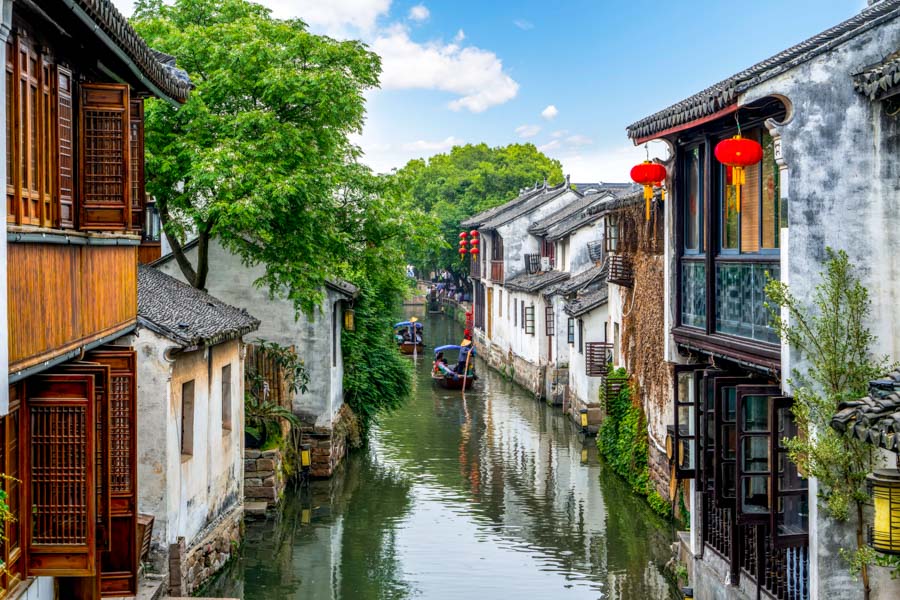
Zhujiajiao offers a range of ways to experience the everyday culture of southern China, combining time on the water with unhurried walks through historic streets. Much of its ancient landmarks have been carefully preserved. Narrow lanes lead past residential quarters, while small shops sell traditional sweets and tea houses open directly onto the canals. Embark on a treasure hunt to discover the Jinle Stele at No. 77 Xijing Street and the Jinwang Stele at No. 242 Beidajie (North Street), as they will unveil their history to those eager to learn.
A walk along North Street, also known as Bei Dajie (大北街), provides another insight into Zhujiajiao’s historic character. This is one of the town’s best-preserved streets, lined with traditional buildings dating from the Ming and Qing dynasties. Small shops, cafés, and workshops create a lively yet measured atmosphere, making it a natural route for a leisurely stroll and for observing daily life in the water town.
You may choose to pause at one of the tea houses set within old waterside buildings. Ordering Chinese tea and watching the steady flow of boats and local activity along the canals allows time to adjust to Zhujiajiao’s slower rhythm.
For an off-the-beaten-path experience, you can arrange a visit to the various wetland parks of Dianshan Lake, located only 2 kilometers (1.2 miles) east of the city.
Places to Visit in Zhujiajiao Water Town
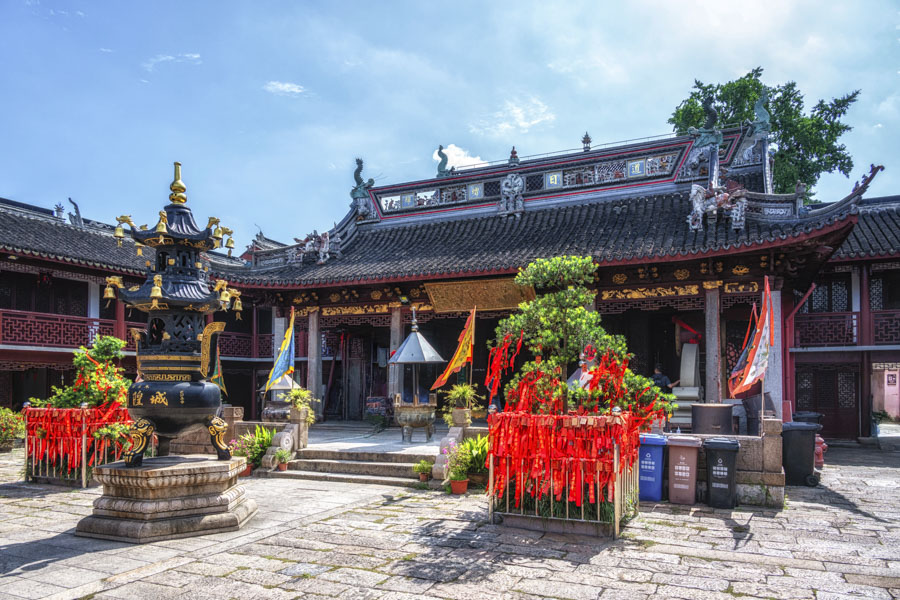
A notable stop is the Zhujiajiao City God Temple (朱家角城隍庙), where much of the historic architecture has been carefully preserved. Inside, visitors can see traditional temple interiors and examples of classical stone carving that reflect the religious and artistic traditions of the region. This Taoist temple stands at 69 Caohe Street (朱家角镇漕河街69号).
Situated along the banks of the Cao Port River, the Buddhist Yuanjin Temple (圆津禅院) is an unmissable attraction in the town. Originally constructed in 1341 during the Mongolian-led Yuan dynasty (1271–1368), the temple was dismantled in the early 1950s, with restoration work commencing in 1999. It offers a serene atmosphere filled with the fragrant scents of incense and features inscriptions carved into stones which are ancient relics. The town is full of of bridges, some of which are more known than others. As you explore, you can traverse them like walkways through time, taking you from one neighbourhood to another.
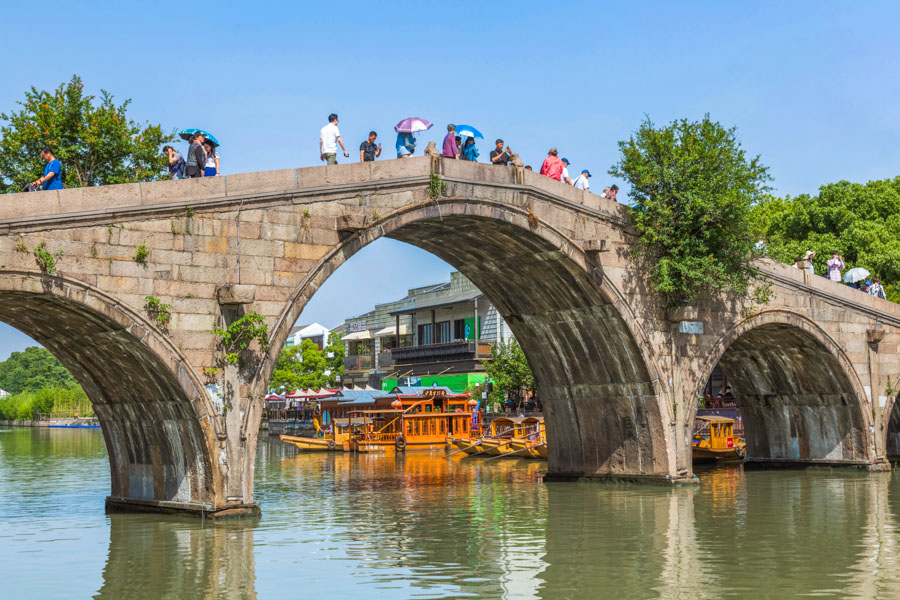
Fangsheng Bridge (放生桥), a large stone bridge with five arches, is among the most recognisable landmarks of Zhujiajiao. Built in 1571, it offers elevated views across the canals, with boats moving below and historic houses lining the water on both sides. The bridge naturally draws visitors as a vantage point and remains one of the most photographed features of the town.
The Tai'an Bridge (泰安桥), on the other hand, is a smaller stone bridge with a half-moon-shaped archway. Its reflection in the water creates the illusion of a circular passage, reminiscent of traditional Chinese gardens. This shape often symbolises harmony, unity, and the connection between different realms. Passing beneath it in a traditional wooden boat feels like transitioning from one world to another. The Yongquan Bridge (永泉桥) serves as the first scenic landmark welcoming visitors to Zhujiajiao; the Yongfeng Bridge (永丰桥)’s balustrade caps are carved with lotus motifs; the Zhonglong Bridge (中龙桥) represents a dragon’s body; the Ping’an Bridge (平安桥) is a three-span flat beam bridge made of granite; the Lang Bridge (朗桥) is the only wooden bridge in the ancient town; and the Yongan Bridge (永安桥) brings wisdom and wealth flowing abundantly if you cross it;and. These are other ancient marvels that you might want to explore. If you pass by 24 Xihu Street, you can pop into the Former Residence of Jin, built in 1926. It is recognisable by its two imposing red gates adorned with gold studs. It belonged to the owner of the famous Yongtaiyuan silk and fabric shop. Located at number, it boasts, among other features, a Shikumen-style courtyard and a garden that lend it an irresistible charm.
Entertainment, Parks, and Shopping in Zhujiajiao Water Town
Beyond walks and sightseeing in the old town, Zhujiajiao also lends itself to quieter forms of leisure, from small museums to cultural spaces. These experiences make it possible to spend more time in the town at a relaxed pace while gaining a deeper sense of its cultural landscape beyond the main canals and landmarks.
Entertainment
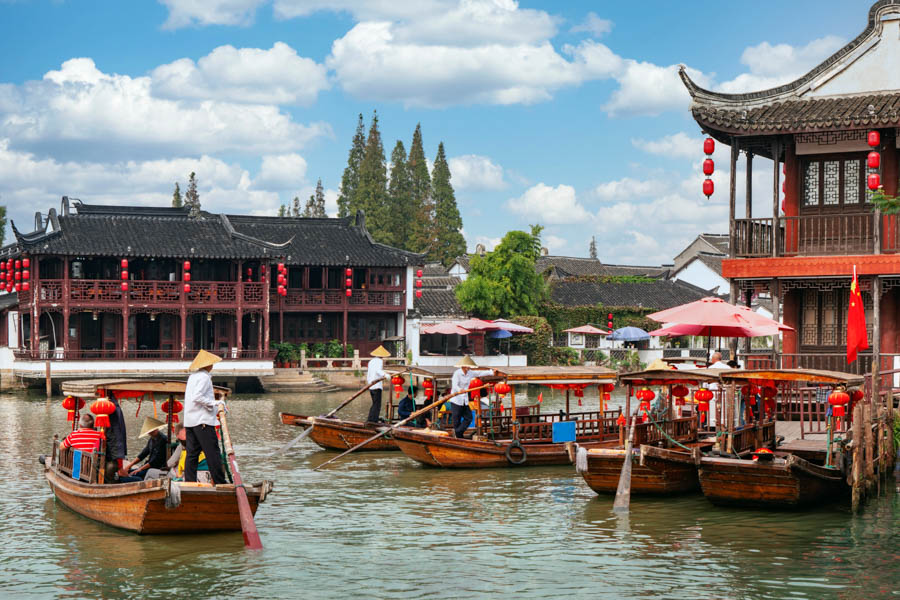
One of the most characteristic experiences is a traditional wooden boat cruise along the canals. Small boats steered by boatmen usually carry up to six passengers and pass beneath stone bridges and alongside old residential façades, offering a close view of the town from the water. Prices typically range from 200 CNY/RMB (approximately $29, £21, €24) for a 15- to 20-minute ride to 300 CNY/RMB ($43, £32, €36) for a 35- to 40-minute ride. A night cruise on the river takes on a whole new dimension, filled with a romantic atmosphere at the rhythmic sound of the boatman's oars.
For an alternative experience, some visitors opt to rent traditional or stylised Chinese costumes from local studios. After choosing an outfit and arranging hair and makeup, it is possible to walk through the town’s bridges, canals, and streets for a photo session. This experience offers a different visual perspective on Zhujiajiao and provides lasting memories framed by its historic surroundings.
When you travel in late spring or early summer, it may be worth experiencing Zhujiajiao during the Dragon Boat Festival (端午节), which takes place on the fifth day of the fifth lunar month, usually falling in May or June. During this period, the town takes on a more festive character, with illuminated streets and a ceremonial boat procession along the canals, often featuring performers dressed in traditional hanfu. The celebrations add a seasonal layer to Zhujiajiao’s historic setting, offering a different perspective on the town’s living traditions.
Museums in Zhujiajiao
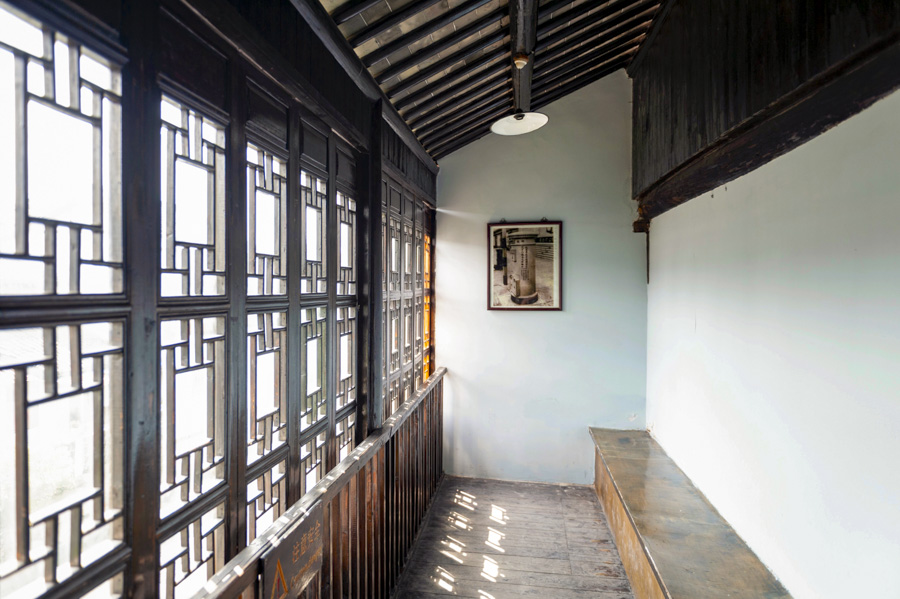
The Zhujiajiao Humanities and Arts Museum (朱家角人文艺术馆) presents exhibitions dedicated to the town’s cultural history. Its collections explore notable local figures, historic temples and monuments, traditional festivals and customs, as well as myths and legends associated with the area. Temporary art exhibitions and cultural events are held here regularly. Additionally, the modern shapes of this museum, designed by the architect Zhu Xiaofeng, stand in stark contrast to the city's traditional style, captivating visitors with an interest in architecture. It incorporates traditional symbols, such as a zigzag stairway reminiscent of traditional zigzag bridges. The museum is located at 36 Meizhou Road, Zhujiajiao Town (朱家角镇美周路36号).
The Quan Hua Watercolor Art Museum, located at No. 121 Xijing Street, serves as the curating institution of the Shanghai Zhujiajiao International Watercolor Biennale. It was founded by the renowned watercolour artist Chen Xidan, who exposes his pieces of art as well as the ones of many watercolour artists.
Exquisite Qing Dynasty lacquer ware, including imperial pieces from the Qianlong period along with Haipai (Shanghai-style) paintings can be viewed at the charming Shanghai Helong Art Gallery located in Miaoqulou. The Jiangnan-style building is adorned with auspicious wood carving motifs, is worth the visit.
Another distinctive stop is the Qing Dynasty Post Office (大清邮局), housed in a restored historic postal building. Inside, visitors can see antique mailboxes, stamps, and postcards while learning how communication networks once functioned in China’s water towns. Today, the building combines a small museum exhibition with cultural and creative spaces, as well as a café. It is situated at 35 Xihu Street, Zhujiajiao Town (朱家角镇西湖街35号).
Zhujiajiao Water Town Theatres
A sensory experience is awaiting you by attending the immersive Kunqu Opera: The Peony Pavilion at Kezhi Garden. This style of opera is on the UNESCO Intangible Cultural Heritage list. The performance has been staged multiple times over the years. Tickets will be available for purchase online when the opera is scheduled. Tan Dun, an Academy Award-winning composer notably known for the soundtrack of Hero, co-produced this opera with Zhang Jun, known as China's "Prince of Kunqu Opera", and the famous dancer Huang Doudou. This collaboration has sparked increased interest from international audiences.
Zhujiajiao Water Town also schedules other innovative cultural events, including "Han-Style Nights" and the "Ultra-Immersive Art Festival", which take place at historical sites.
Parks of Zhujiajiao Water Town
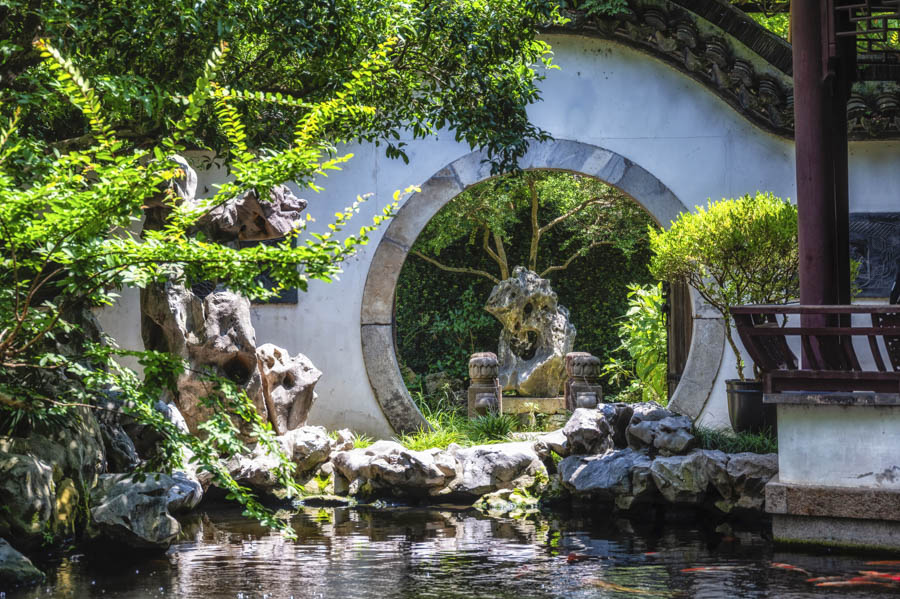
Zhujiajiao’s gardens and parks provide tranquil spaces for rest and contemplative walks, creating a clear contrast to the busier streets and waterways.
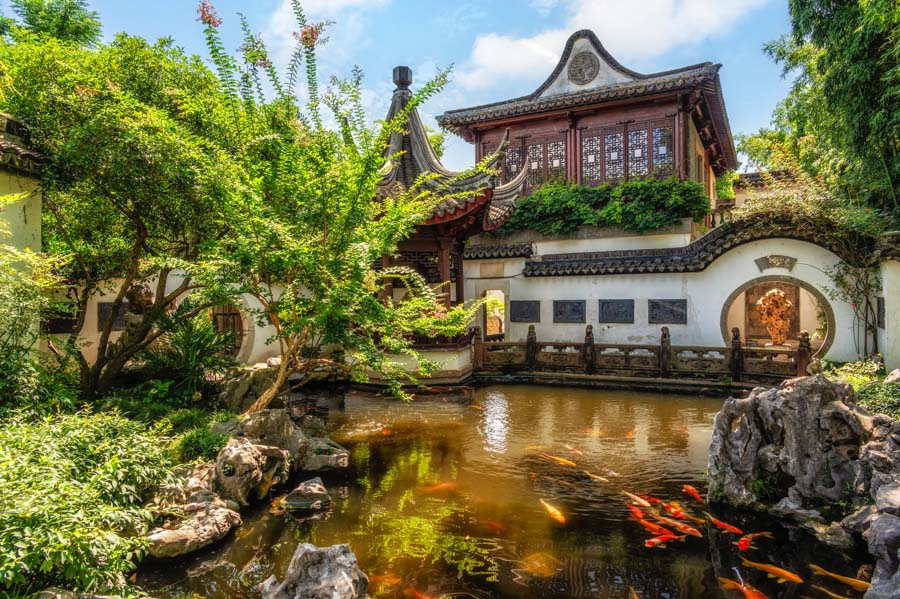
A stroll through Kezhi Garden (课植园), the largest private classical garden in Zhujiajiao will reveal a layout that blends traditional Chinese garden design with subtle European landscape elements. Winding paths pass ornamental ponds and pavilions, while small viewing points reveal the garden from shifting perspectives. Its Library, Wangyue Tower, Lion Pavilion, and Nine-Bend Zigzag Bridge are the most iconic buildings there. Ephemeral performances of Kunqu opera are sometimes hosted, here, in the summer.
Hexin Garden (和心园), also known as the Garden of Inseparable Hearts, is a more intimate green space located on Xijing Street and adjacent to the Kezhi Garden. Covering around 3,000 square metres, it is organised around water features, pavilions, stone arrangements, and dense planting. The garden takes its name from the Hexin Pavilion, originally built during the Qing dynasty and later relocated here. Carefully framed views and quiet corners shape a calm, reflective atmosphere. The garden also operates as a history and culture museum.
On the eastern edge of the town, Zhuxi Park (珠溪园) presents a broader park landscape. Paths wind through greenery, ponds, fountains, stone bridges, and pavilions, with features such as a group of twelve stone-carved zodiac statues and a camphor tree estimated to be around 150 years old. The park also includes small attractions for children, making it suitable for families, and a typical visit lasts around one to two hours.
Shopping in Zhujiajiao Water Town
Many visitors enjoy strolling along the shopping streets of North Street, also known as Bei Dajie (大北街), and Xijing Street (西井街). Browsing antique-style interiors, speaking with shopkeepers, and selecting handmade crafts become a natural part of a walk through the old town.
Freshwater pearl jewellery is among the most recognisable local souvenirs, closely associated with Zhujiajiao. In some shops, visitors can select an oyster, which is opened on the spot before its pearl is set into a finished piece of jewellery. This process adds a distinctive, hands-on dimension to the purchase and reflects long-standing regional traditions linked to pearl cultivation.
It is also worth choosing artworks made through traditional craft techniques, many of which reflect local materials and skills. Common items include sun musical instruments, combs carved from natural stone or wood, calligraphy scrolls, hand-painted fans, bamboo and textile household goods, utensils used in the tea ceremony, and aromatic herbal blends. Together, these objects offer a varied and tangible connection to the craft heritage of the region.
Travellers interested in learning more about Chinese culture may wish to stop at Tong Tianhe Traditional Chinese Medicine (童天和国药号), an old-style shop. Shelves are filled with dried herbs, roots, syrups, and other medicinal ingredients. The shop preserves the atmosphere of a working apothecary and offers a glimpse into local traditions that remain part of everyday life. It is located at 60 Daxin Street (朱家角镇大新街60号).
Ultimately, Handalong, Apo Tea House, founded in 1886 by the Wu family, sells soy sauce, pickles, rose-fermented tofu, and vinegars, all made according to secret ancestral recipes.
Food in Zhujiajiao Water Town

Food is an essential part of a visit to Zhujiajiao, offering a chance to explore flavours typical of southern Chinese and Jiangnan cuisine.
Chinese Cuisine
Those curious about more unusual flavours may encounter a range of novelty street foods, including dishes made with snails, fried scorpion, deep fried grasshoppers, or even starfish served on skewers. While not part of everyday local cuisine, these items are occasionally offered as culinary curiosities and add an unexpected dimension to Zhujiajiao’s street-food scene.
Beyond street snacks, Zhujiajiao also offers a wide choice of restaurants suitable for full lunches and dinners. Many establishments focus on regional cooking, using fresh river fish, seasonal vegetables, and a variety of meat dishes that reflect the food traditions of the Jiangnan region. Dining here often becomes a natural continuation of a walk through the old town.
Yunyige Restaurant Firewood Rice (新芸逸阁饭庄柴火饭) is known for its traditional atmosphere and dishes prepared over an open fire. This cooking method recalls older regional practices and fits well with the historic surroundings of Zhujiajiao’s central streets. Address: 135 Xijing Street (朱家角镇西井街135号)
Another long-established option is Zhenhe Restaurant (枕河酒家), a classic venue serving local specialities and seasonal dishes. Its setting makes it a comfortable choice for an evening meal after time spent walking along the canals. Address: 62 Caohe Street (朱家角镇漕河街62号)
Jinling Restaurant (金龄餐厅) is a popular choice for both family meals and larger groups. Its menu offers a broad selection of traditional dishes suited to different tastes and dining preferences. Address: 114 Xijing Street (朱家角镇西井街114号)
Vegetarian Restaurants
Visitors can begin by trying local tofu specialities, including stinky tofu (臭豆腐) and five-spice tofu (五香豆腐), which are commonly prepared at street stalls and served freshly cooked. Another distinctive local flavour is rose-scented fermented bean curd (玫瑰腐乳), known for its sweet aroma and rich taste. Traditional snacks also include zongzi (粽子), sticky rice wrapped in bamboo leaves, as well as dishes made with lotus root (莲藕), a widely used ingredient in Jiangnan cooking.
Although there might not be typical vegetarian restaurants in the city, visitors can always order fresh-made dishes with local vegetables and fruits.
Tea Houses, Bakeries, and Patisseries
For drinks, it is common to sample hawthorn tea (山楂茶), often sold warm or chilled depending on the season. A walk through the old town is frequently accompanied by sweet treats such as tanghulu (糖葫芦), skewers of fruit coated in hardened sugar syrup, and Niupi tang (牛皮糖), chewy candies traditionally sold in historic shopping arcades.
Popular places include Grandma’s Teahouse, One Step Garden, Club Teahouse, and Xiao Ban Café, each offering a quiet setting by the water.
City Transport in Zhujiajiao Water Town
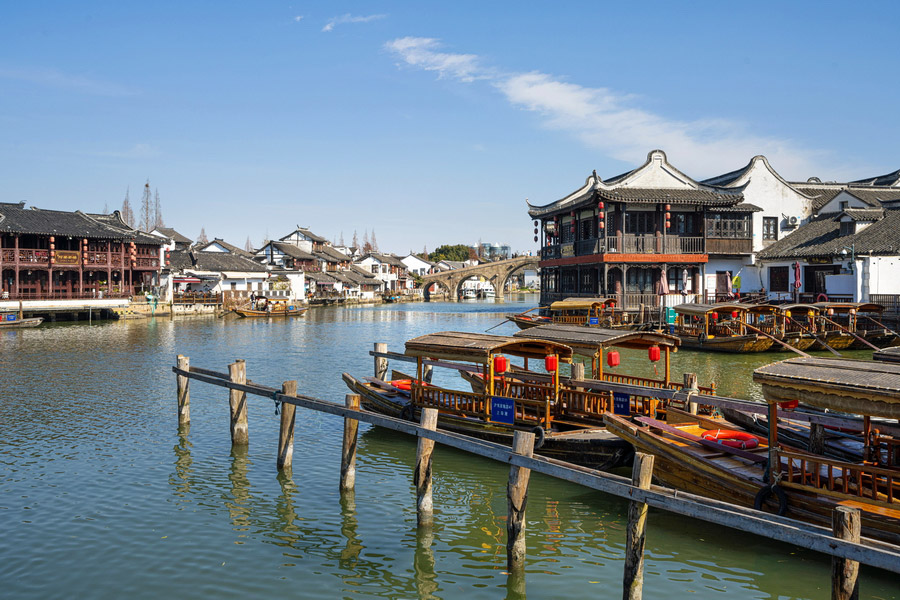
Getting around Zhujiajiao is centred primarily on walking, as the historic centre of the town remains compact and shaped by its traditional layout of canals, bridges, and narrow streets. Most routes follow the logic of the old water-town structure rather than modern transport patterns.
Although the main sights of Zhujiajiao are concentrated within the old town and are easily reached on foot, travelling by boat is another option.
Several piers provide access to canal routes, including Kezhi Garden Warf (课植园码头), Great North Street Warf (大北街码头), Fangsheng Bridge Warf (放生桥码头), and City God Temple Warf (城隍庙码头). Together, these connections make it easy to combine walking with short boat journeys when exploring different parts of Zhujiajiao.
How to Get to Zhujiajiao Water Town?
There are several convenient ways to get to Zhujiajiao Water Town from central Shanghai, with public transport providing the most practical options for visitors.
Metro
One of the easiest ways to reach Zhujiajiao is by taking Metro Line 17 in Shanghai, which connects Hongqiao Railway Station (虹桥火车站) directly with Zhujiajiao Station (朱家角站). The journey takes around one hour and follows a clear, straightforward route, making it a convenient and inexpensive option for a day trip.
Buses
Several bus routes connect Shanghai with Zhujiajiao. Tourist buses operate from Shanghai Stadium (上海体育场), departing every 30 minutes between 7:30 a.m. and 11:00 a.m. from Gate 5 and Gate 12. They take about one hour to reach Zhujiajiao. Return buses to Shanghai generally run until around 4:00 p.m., which is worth considering when planning a visit.
Regular intercity buses also depart from Puan Road Bus Station near People’s Square. The fastest option is the Huzhu Gaosu Kuaixian (沪朱高速快线), an express bus route. Departures are typically scheduled every 30 minutes, and the journey takes about 70 minutes. The final stop is at Zhuxi Garden (朱溪园), from where the historic part of Zhujiajiao can be reached on foot in roughly ten minutes. The last bus back to Shanghai usually leaves at around 7:30 p.m., an important detail for those planning to return the same day.
Additional routes are available from Shanghai West Bus Station (上海西站汽车站) and Shanghai South Railway Station (上海南站). These services operating from 06:00 a.m. to 21:00 p.m. generally involve transfers and take longer than the direct express buses, making them a less convenient choice for most visitors.
Taxi
For a more comfortable and flexible journey, travelling by taxi or with a private car and driver is another option. This approach suits visitors who prefer a personalised itinerary or are travelling with luggage, family members, or in a small group.
In Shanghai, several large ride-hailing platforms operate via mobile applications, including Didi Chuxing, Xiangdao, and Gaode.
Taxis can also be ordered by phone through Qiang Sheng Taxi Co, one of Shanghai’s largest taxi operators, which offers English-speaking assistance via its hotline (62580000). In addition, taxi services are integrated into Shanghai’s MaaS (Mobility as a Service) platform, which brings together different modes of transport within a single app.
Languages Spoken in Zhujiajiao Water Town
In Zhujiajiao Water Town, as elsewhere in China, the primary language of communication is Putonghua (普通话), known as Mandarin, the standard form of spoken Chinese.
Alongside Putonghua, the local Shanghai dialect, commonly known as Shanghainese (上海话), remains widely spoken among residents and the older generation. Shanghainese belongs to the Wu (吴语) language group.
Visitors can feel confident even if they don’t speak Mandarin. Direction signs, route maps, and museum captions are generally provided in both Chinese and English. Menus in cafés, teahouses, and restaurants, however, are often written only in Chinese. In these cases, photographs, basic English explanations, or mobile translation applications are commonly used when ordering.
Currency & Payments in Zhujiajiao Water Town
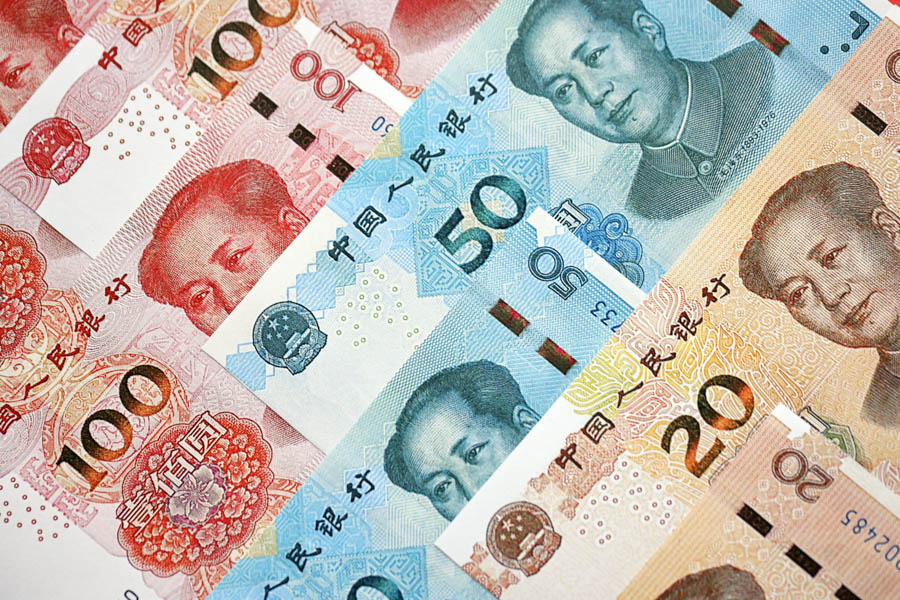
The official currency in Zhujiajiao, as throughout China, is the Chinese yuan (CNY, also referred to as RMB). Foreign currencies are not accepted, so it is important to ensure access to yuan before visiting the town.
The most common method of payment in Zhujiajiao is mobile payment, primarily through Alipay and WeChat Pay. These services are widely used in museums, shops, cafés, teahouses, and restaurants, as well as at street stalls and small markets.
International bank cards are accepted only to a limited extent and usually only in larger cities.
ATMs are scarce within the historic part of Zhujiajiao Water Town, so it is advisable to withdraw cash in advance, either in Shanghai or near the entrance to the main tourist area. Currency exchange facilities are limited, and visitors should not rely on being able to exchange money once inside the water town.
Overall, the most convenient approach when visiting Zhujiajiao Water Town is to combine cash in yuan with access to one of the widely used mobile payment apps.
Security in Zhujiajiao Water Town
Zhujiajiao Water Town is generally regarded as a safe and well-organised destination for visitors. The old town is actively visited by both domestic and international travellers, and public order is maintained through the regular presence of security staff and police in key areas.
In the evening, the town remains lively with adequate lighting, while retaining a calm atmosphere, making it comfortable to walk around after sunset.Stone bridges and waterside paths can become slippery, particularly in wet weather.
In areas with higher visitor density, it is advisable to keep personal belongings secure and avoid wearing large backpacks in narrow passages.
Boat trips along the canals are operated by licensed providers. Passengers board and disembark at designated piers and are expected to follow the boatmen’s instructions. Standing while the boat is moving is discouraged, especially when passing beneath low bridges.
For the convenience and safety of visitors, a range of facilities is available near the main entrances to Zhujiajiao Water Town and close to the Zhujiajiao Ancient Town Tourist Centre.
Overall, Zhujiajiao Water Town is well suited to independent exploration, including for families with children and older visitors, provided basic care is taken when navigating its historic streets and waterways.